
Downers Grove Epoxy Flooring grinds and polishes polished concrete floors in Downers Grove, IL, serving surrounding cities including Hinsdale, Burr Ridge, Western Springs, La Grange and Westchester. With more than 20 years on concrete, we know that the finish you end up with is decided by the slab you start with, so every polished floor begins with an honest look at the concrete and a test section before the full grind is set.
Polished concrete is not a coating. It is the floor itself, ground in passes with finer and finer diamond tooling, hardened with a lithium silicate densifier, and honed to the sheen you choose. Done right, it gives a showroom, office, warehouse or modern home a durable, low-maintenance floor with no film to peel and no topcoat to wear through.
Our proposals name the grit sequence, the densifier, the guard and the level of aggregate exposure, so the finished floor can be checked against the paper. Below we explain the finish choices, how the work runs, where polished concrete fits and where it does not.
Commercial Polished Concrete Floors
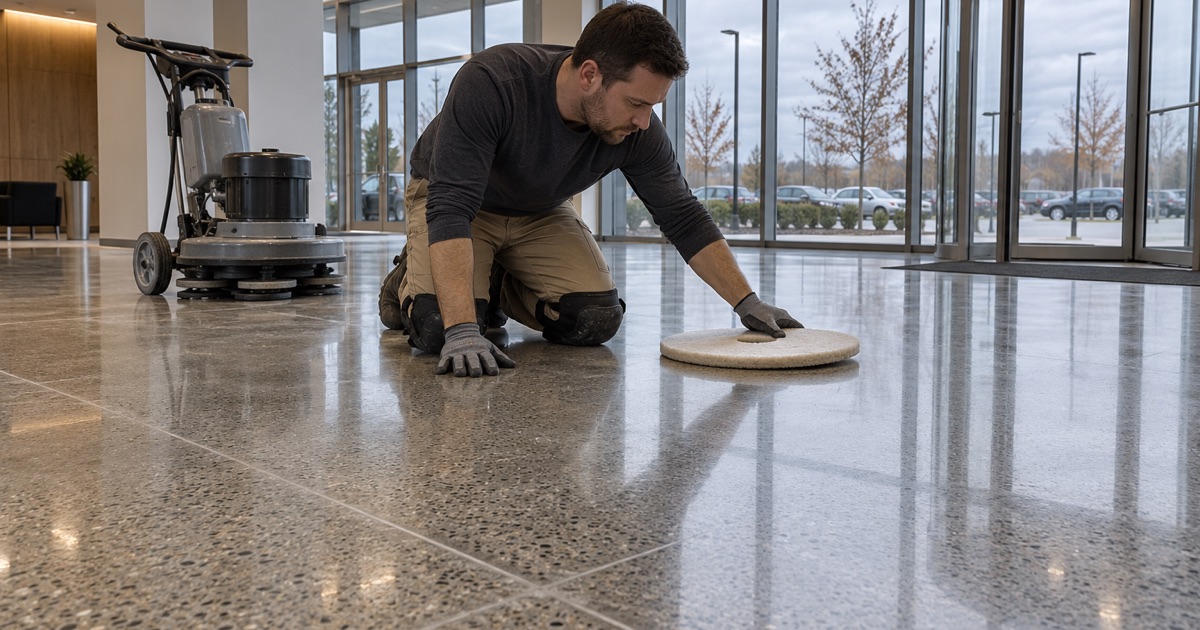
Retail Showrooms and Office Lobbies
A showroom or lobby floor is part of the presentation, and polished concrete reflects light in a way that brightens a space without a glossy plastic look. It takes daily foot traffic and rolling displays well, and burnishing between cleanings keeps the shine up in front of customers.
We phase showroom and office polishing around opening hours, with overnight and weekend windows when a space cannot close. Dust is captured at the grinder with a vacuum, which matters when merchandise, furniture and HVAC returns are a few feet away.
Warehouses and Light Manufacturing
In warehouses and light manufacturing spaces, densified and polished concrete resists dusting, the slow powdering of an untreated slab under forklift and pallet jack wheels. It also reflects overhead lighting, brightening aisles, and it avoids the recoat cycle a thin coating demands in heavy travel lanes.
Safety striping, aisle lines and parking stall markings can still be added on a polished warehouse floor with a compatible line paint or a narrow coated band. We plan those markings with the floor layout, so forklift lanes, pedestrian walkways and dock approaches are laid out once rather than painted over a finished polish.
Restaurants, Breweries and Event Spaces
Polished concrete works well in dining rooms, taprooms and event spaces where a durable, easily cleaned floor carries a lot of foot traffic. For back-of-house kitchens and wet production areas, we usually recommend a seamless urethane cement or epoxy system with a coved base instead, because health department plan review and constant washdown favor a different floor.
Residential Polished Concrete
Modern Homes and Main-Floor Slabs
Some homeowners want the clean, minimal look of polished concrete on a main-floor slab, a sunroom or an addition. It pairs well with radiant heat, holds up to pets and kids, and needs nothing more than dust mopping and an occasional damp clean.
Basement Floors and Moisture
A polished basement floor can look striking, but it rests on the same slab that sees ground moisture all year. We test the slab first, because vapor moving through it can carry salts up to the surface as efflorescence and leave white haze on a fresh polish. Many Downers Grove basements were poured in the mid-century era and carry paint, patches and tile adhesive that have to be ground off before polishing can begin.
Finish Choices: Aggregate Exposure, Sheen and Color
Cream, Salt-and-Pepper or Exposed Stone
How deep the first grind goes decides what you see. A light grind keeps the cream, the smooth top layer of the slab, for a uniform look. A medium grind reveals fine aggregate in a salt-and-pepper pattern, and a deeper grind exposes larger stones across the floor.
Every slab has a different mix and a different finish height, so we grind a test pass to show you the exposure before committing to the whole floor. Once a slab is ground deep, it cannot be put back, which is why this choice comes first.
Matte, Satin and High Gloss Sheen
Sheen is set by how far the honing goes up the grit scale. A matte or satin polish hides everyday wear and reads calm under bright light, while a high-gloss polish reflects like glass and shows more scuffs in heavy traffic. We help you choose based on the space and the traffic rather than on a sample in a showroom.
Dyes, Stains and Saw-Cut Patterns
Penetrating dyes can warm or deepen the color of the slab, blend stains, or create bands of color for wayfinding. Saw-cut lines scored into the slab can form tile patterns, borders or a logo, which works especially well in lobbies, showrooms and restaurants.
Color is easiest to adjust before the densifier goes down, so we settle dye choices during the test section. A dye sample on your own slab is the only reliable preview, because the same dye reads differently over cream, fine aggregate and exposed stone.
Polished Concrete Compared With Epoxy and Other Floors
When Polished Concrete Is the Better Choice
Polished concrete makes the most sense on a sound, reasonably dry interior slab that carries steady foot traffic, rolling carts or light forklift work. With no film on top, there is nothing to peel, no hot tire pickup and no topcoat to recoat on a schedule, and the long-term upkeep is mostly cleaning and periodic burnishing.
It also suits spaces where a coating would struggle with the slab itself. A floor with moderate moisture vapor coming through it, for example, can often be densified and polished where a sealed film coating would need a moisture-mitigation primer first, although efflorescence can still show up on the surface.
When an Epoxy or Urethane System Fits Better
Garages are usually a better fit for a coated system, because road salt, brine and hot tires are hard on a bare polished surface and a broadcast coating hides grit and staining. Commercial kitchens and wet production rooms usually need a seamless urethane cement or epoxy system with a coved base, which a polished slab cannot provide.
Spaces with heavy chemical exposure, such as battery rooms or some light manufacturing floors, also tend to call for a resin system with chemical resistance matched to what will be spilled. We will tell you plainly when a coating will outperform polishing on your floor, even though both are services we sell.
Slabs That Need Repair First
A polished floor shows the slab exactly as it is, so heavy spalling, wide cracks and badly patched areas show through the finish. Cracks, spalls and old coatings are mapped first, and when a slab needs repair or replacement before polishing makes sense, we say so in the estimate rather than after the grinder has opened it up.
Our Step-by-Step Polished Concrete Floors Process
Step 1: Slab Assessment and Test Section
We check hardness, cracks, joints, patches, old adhesive and moisture, then grind a test section to show the aggregate exposure and sheen your slab can reach. The written scope follows, naming the grit sequence, the densifier and the guard.
Step 2: Grinding and Repairs
The slab is ground with metal-bond diamonds to remove coatings, adhesive and surface defects and to set the aggregate exposure. Cracks and joints are filled with a matched repair material so they read as part of the floor rather than as patches.
Step 3: Densifying and Honing
A lithium silicate densifier is applied to harden the surface and reduce dusting, then the floor is honed through finer resin-bond diamond grits. Each pass refines the scratch pattern left by the one before it, which is what produces clarity rather than a hazy shine.
Step 4: Polishing, Guard and Care Plan
The final passes bring the floor to the chosen sheen, and a penetrating guard helps the surface resist stains. We leave a care plan covering daily cleaning, the cleaners to avoid, and how often to burnish in high-traffic areas.
- 20+ Years of Floor Work
- Moisture Tested in Writing
- Free Written Quotes