
Downers Grove Epoxy Flooring installs epoxy garage floor systems in Downers Grove, IL, serving surrounding cities including Hinsdale, Burr Ridge, Western Springs, La Grange and Westchester, and we have been grinding and coating concrete for more than 20 years. A garage floor here works harder than almost any floor in the house: it takes snowmelt, road salt, dropped tools and hot tires, often on a slab that was poured with no thought of ever being coated.
That is why our garage work starts with the concrete rather than the color card. Each slab is opened with a diamond grinder or a shot blaster, tested for moisture, and repaired before any epoxy is mixed, and the written proposal names the product line, the number of coats and the finished thickness you are paying for. When a garage slab is too far gone to coat, we say so before we quote.
The sections below explain how we choose a garage system, how we handle the local conditions that wreck cheap coatings, and what a garage floor job looks like from the first visit to the day you pull the car back in.
Garage Floor Coating Systems We Install
Full-Broadcast Vinyl Flake Garage Floors
Our most requested garage system is a 100% solids epoxy base coat with a full vinyl flake broadcast, scraped flat and locked under a clear topcoat. A full broadcast, rather than a light scatter of chips, gives the floor a thicker body, hides grit and tire marks between cleanings, and adds texture underfoot.
Flake blends run from tight, fine chips that read like granite to large, bold chips in mixed colors. We bring sample boards to the estimate so you can see a blend against your own walls and lighting rather than a photo on a screen.
Quartz Broadcast for Grip and Abrasion
Where a garage doubles as a workshop or takes heavy foot traffic in wet boots, a quartz aggregate broadcast gives more grip and abrasion resistance than flake. The colored quartz is seeded into the wet epoxy, then sealed, leaving a fine sandpaper texture that stays in place under tools and dropped hardware.
Solid Color and Metallic Garage Finishes
Some owners want a clean, solid color floor for a workshop or a display garage, and others want the marbled depth of metallic epoxy under a collector car. Both are installed over the same ground and tested slab, and both get a protective topcoat sized to the traffic the garage actually sees.
Polyaspartic and Polyurea Topcoats
The topcoat is the layer your tires touch, so we treat it as the most important choice in the system. Polyaspartic and polyurea topcoats hold their color in sunlight, resist abrasion and chemicals, and cure quickly, while a plain epoxy topcoat can amber where daylight comes through an open door.
What Downers Grove Winters Do to Garage Floors
Rock Salt, Brine and Spalling
Every car that comes home from a salted road carries calcium chloride and rock salt brine into the garage. On bare concrete that brine soaks in, recrystallizes as it dries, and pops off the top layer of the slab, which is why so many older garages show pitting and flaking near the door and under the tires.
A coated garage floor keeps that brine on the surface where a squeegee or a hose can move it out. We build the system thick enough, and choose a topcoat chemically resistant enough, that a winter of salt leaves the floor dull at worst rather than eaten through.
Hot Tire Pickup From Highway Driving
Tires coming off Interstate 88 or Interstate 355 on a summer afternoon are hot, and a hot tire softens a thin coating, grips it, and lifts it as the tire cools. That failure, called hot tire pickup, is the classic sign of a store kit or a single thin coat. Thick 100% solids epoxy over a ground profile, with a polyaspartic topcoat, is built to resist it.
Unheated Garages, Cold Slabs and Cure
Epoxy cures by chemical reaction, and a cold slab slows that reaction to a crawl. We read the slab temperature and the dew point spread at the surface before every coat, because a slab sitting near the dew point collects a film of moisture that can cause amine blush and a weak bond.
An unheated or detached garage in deep winter is told to wait for warmer weather. A floor coated on a frozen slab may look fine on day one and then soften, cloud or peel, so we would rather schedule you for spring than come back to fix it.
Garage Floor Care Through Salt Season
A coated floor makes winter cleanup simple, but it still rewards a little attention. Squeegee standing slush toward the door after a storm, rinse the floor on a mild day, and keep a mat where boots come in from the driveway. Grit left to grind under tires is what dulls a topcoat fastest, so a quick sweep does more than any cleaner.
Slab Preparation, Testing and Repair
Diamond Grinding to a Real Surface Profile
A coating grips the texture of the concrete, not the concrete itself, so we grind every garage slab to a measured ICRI concrete surface profile. Diamond grinding removes the weak top cream, old sealers and oil-soaked concrete, while acid etching, the method in most kits, leaves a shallow and uneven surface with residue that interferes with bonding.
Moisture Testing Before the Price Is Final
Garage slabs can carry more moisture than people expect, especially older slabs with no vapor retarder under them. We include a moisture test in the written scope, starting with the ASTM D4263 plastic sheet test and moving to calcium chloride or in-situ relative humidity probes when the slab calls for it. If the readings are high, a moisture-mitigation primer goes into the system before the price is final.
Crack, Spall and Joint Repair
Cracks, spalls and pitted areas are mapped during the estimate and repaired after grinding with fillers matched to the damage. Settled sections, heaved slabs and widespread scaling are a different conversation: if a garage slab needs replacement rather than coating, we tell you plainly and explain why.
New Garage Slabs and the Village Vapor Retarder Rule
When a garage slab is being replaced rather than coated, the new pour has rules of its own. Downers Grove amends the International Residential Code to delete the exception that elsewhere lets a garage slab skip its under-slab vapor retarder, and attached garages keep their gas curb or step below the house foundation. We point to those village requirements before anyone quotes a coating on a slab that has not been poured yet.
Our Step-by-Step Epoxy Garage Floor Process
Step 1: Slab Check and Written Scope
We look at the slab, map cracks and old coatings, run the moisture test, and write a scope that names the product line, the coats, the broadcast and the finished thickness. Home jobs over the state threshold get a written contract and the Illinois consumer-rights pamphlet before any work begins.
Step 2: Grinding With Dust Capture
The slab is diamond ground with a vacuum attached at the machine, so the fine concrete dust is bagged rather than blown into the house or rinsed toward the floor drain. Edges along walls and steps are ground by hand so the profile runs right to the corners.
Step 3: Repairs and Base Coat
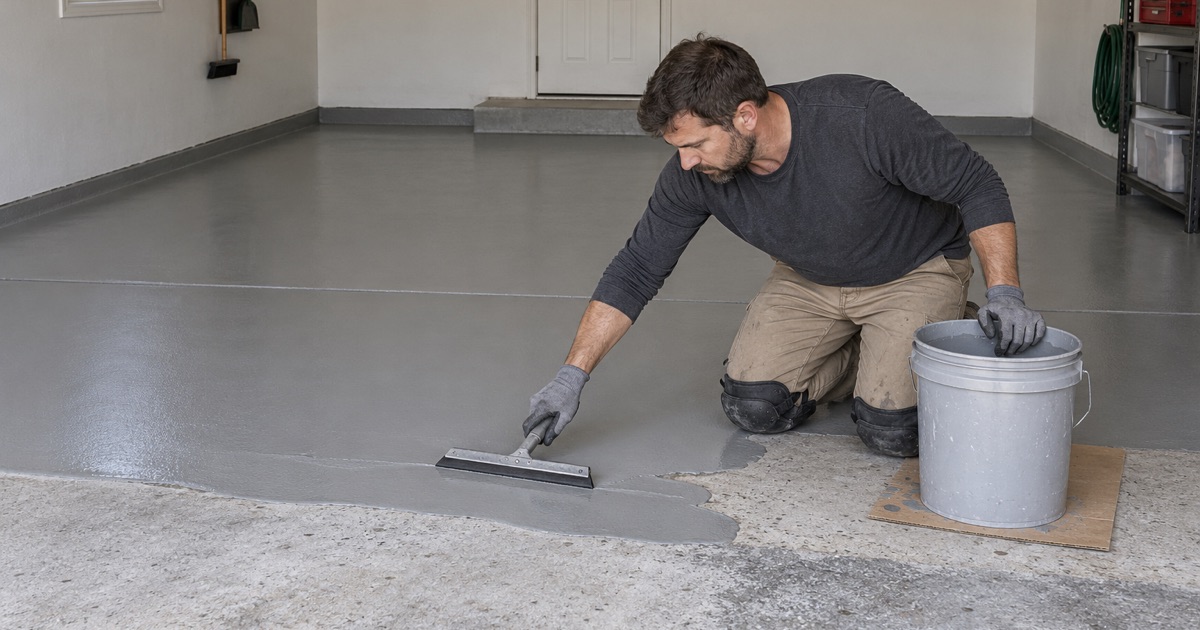
Cracks and spalls are filled and ground flush, then the base coat of epoxy goes down and the flake or quartz is broadcast into it while it is still wet. The broadcast cures, then the loose material is scraped and vacuumed off.
Step 4: Topcoat and Return to Service
The clear topcoat seals the broadcast and sets the sheen and texture of the finished floor. We leave you with written walk-on and drive-on times, plus simple care instructions for getting through the first salt season.
- 20+ Years of Floor Work
- Moisture Tested in Writing
- Free Written Quotes